The Things I Cannot Fix

October 18th started like any other day.
I met the morning bright and early, waking up to feed Beckham before getting ready for work.
When I left the house that morning, I had no idea that our 4 a.m. snuggles would be the last time for the next several days that I would hold him without fear or anxiety flooding my mind.
While I was at work, I sent Julian my occasional check-in texts:
“Is he okay?”
“Have you cathed him?”
“Has he eaten?”
Side note: My husband absolutely loves these texts.
Narrator: He does not.
I’m sure sometimes he feels like I’m questioning his ability to care for Beckham, which isn’t the case at all. I just can’t seem to turn off the part of my brain that worries about Beckham when I’m not the one directly caring for him.
Julian let me know that Beckham seemed to be having a good day. He was happy and content and even took a good nap in his bassinet—which rarely happens.

The only thing that seemed strange was that he wasn’t very interested in eating.
Initially, I wasn’t overly concerned. Beckham has always eaten less from a bottle than he does breastfeeding.
But this time was different.
From the time I nursed him around 4 a.m. until I got home from work around 2:30 p.m., he had only taken about two ounces.
60 mL.
That’s it.
When I got home, he was sitting on Julian’s lap. He looked tired, but otherwise, he seemed okay.
I figured he had to be starving, so I took him upstairs to nurse him and hopefully put him down for a nap.
As I fed him, I gently ran my fingers across the top of his head.
And my stomach dropped.
His soft spot was extremely full—almost bulging.
I immediately texted Julian to ask if he had noticed this during the day.
He had, but he didn’t want to worry me.
And in all fairness, Beckham’s fontanelle has felt full before. There were times it would feel full for a while, and then eventually his shunt would drain the extra fluid and his soft spot would flatten again.
So I tried to reassure myself.
This is one of those days.
Give it a little time.
The shunt will drain.
But as another hour passed.
It wasn’t getting softer.
It was getting fuller.
So Julian and I decided it was time to take him to the emergency room to have his shunt evaluated.
We both packed overnight bags with the essentials because, deep down, I don’t think either of us believed we would be coming home that night.
Call it intuition.
Call it pessimism.
Call it a mother’s instinct.
But I knew.
I knew in my gut that his shunt wasn’t working.
And I knew what that meant.
Another hospitalization.
And even worse, another surgery for our sweet boy.
Before leaving, I forced myself to eat something. I had barely eaten all day, and I knew that once we arrived at the hospital, food would probably become an afterthought.
As I sat there eating, I looked at Julian and said:
“I don’t want them to shave his head again.”
Suddenly, all of the fear and emotion I had been holding back broke through—and so did the tears.
And part of me thought, Really, Hailey? His hair? That’s what you’re worried about right now?
It wasn’t.
I wasn’t really crying about his hair.
I think my brain simply couldn’t process the magnitude of what I truly feared was coming. It couldn’t yet face another shunt failure. Another hospital admission. Another surgery.
And worst of all, watching my baby go through more pain and suffering.
So instead, it chose something small.
His hair.
Something I could wrap my mind around when everything else felt too enormous to comprehend.
The Words I Already Knew Were Coming
Once we arrived at the emergency room, we were quickly called back so they could evaluate Beckham and check his vital signs.
Next, they ordered a “shunt series,” which included a CT scan and several X-rays. Once his imaging was complete, we were placed in an ER room and waited to hear what would come next
The ER physician told us she was paging neurosurgery.
And then we waited for what felt like an eternity.

Finally, a neurosurgery resident walked into the room.
And then he said the words I feared most—the words I already knew in my gut were coming:
“Beckham needs his shunt revised.”
His imaging showed that the tip of the catheter was no longer positioned inside his ventricle, meaning it could no longer adequately drain the excess cerebrospinal fluid accumulating in his brain.
My next question:
“When are you taking him to surgery?”
My heart sank with his response:
“Sometime tomorrow.”
I wanted them to fix it now.
I wanted the pressure relieved from my baby’s brain. I wanted him to feel better. And selfishly, I wanted to get the surgery over with so we could focus on healing.
But Beckham was stable.
Even though we knew his shunt wasn’t working, he was stable enough that they didn’t need to take him into surgery immediately.
The medical professional in me understood that.
Plus, it was already after 8 p.m., and I knew that having a rested surgical team the following day was not necessarily a bad thing.
So I accepted that tomorrow was the safest plan.
It gave them time to get labs, start an IV and fluids for his dehydration, admit us to the neurosurgery floor, and hopefully give all of us a little time to rest before another overwhelming day.
Learning to Advocate for Him
First on the list was the IV.
And I was dreading it.
Two nurses came in with their supplies and began searching for veins. One explained that they would try the veins they could see and feel first, and if those attempts failed, they would use ultrasound guidance.
There was a little voice inside my head saying:
Tell them no.
Ask them to get the ultrasound now.
But then the medical professional in me took over.
Let them try.
Maybe they’ll get it on the first or second attempt.
Don’t be that parent.
Don’t be difficult.
One nurse tried twice.
Both attempts failed.
Another nurse tried.
That attempt failed too.
Finally, they brought in the ultrasound.
The fourth attempt was successful.
And every single attempt was horrible to watch.
They would wrap Beckham tightly in several blankets like a little burrito, and Julian and I would help hold his body still. I stayed near his face, dipping his pacifier in Sweet-Ease and trying desperately to comfort and distract him while they searched for a vein.
But every time, without fail, he would scream the moment the needle punctured his skin.
And the seconds between that initial poke and watching them search beneath his skin for the vein felt like an eternity.
He would fight against us, thrash his head from side to side, and look directly at me with those big eyes as if he were asking, Mommy, why are you letting them hurt me?
And there I was—holding him down while someone hurt him.
I knew they weren’t actually hurting him. They were trying to help him. He needed an IV. He needed fluids.
But try explaining that to a four-month-old baby.
He didn’t understand why it was happening.
He only knew that it hurt.
And we both hated every single second of it.
Why hadn’t I listened to that voice?
Why had I been more concerned about appearing “difficult” than simply saying what I believed my child needed?
I wish I had spoken up sooner.
But medical parenting has taught me that advocacy is something you learn, too.
Sometimes you learn it through moments you wish you could redo.
At work, advocating for my patients comes naturally to me. Maybe that’s because it’s a skill I’ve learned, practiced, and strengthened over years of working in healthcare. I know when to ask questions. I know when something doesn’t feel right. And I know when to speak up.
You would think advocating for my own child would come even more naturally.
But strangely, it doesn’t always.
Maybe part of that is because I’m constantly trying to navigate the space between being a medical professional and simply being Beckham’s mom. I want to be a strong, confident voice for my child, while also respecting the medical professionals caring for him. I never want my knowledge or experience to come across as arrogant, demanding, or difficult.
But I’m learning that there will be times when I have to stop worrying about how I might be perceived and trust the voice inside me that says, Speak up.
So next time, I will.
If advocating for my child makes me “difficult,” then I am learning to be okay with that.
Because Beckham cannot advocate for himself yet.
That is my job.
The Longest Night
Once the IV was finally in and his labs were drawn, we waited to be transferred upstairs.
Sometime after midnight, a room was finally ready.

Once we settled in, my next concern was Beckham’s bladder.
His catheter volumes at home had been steadily decreasing throughout the day, another sign that he was dehydrated. But now he was receiving continuous IV fluids, and I had no idea how quickly his urine output might increase or how frequently we would need to cath him.
I asked the nurse if we could discuss placing a Foley catheter—a catheter that remains in the bladder and continuously drains urine.
The doctor agreed, and once it was placed, that was one less thing we had to worry about overnight.
Then the nurse let me feed Beckham one last time before he became NPO—“nothing by mouth”—in preparation for surgery.
I sat there in the darkness, feeding my sweet boy.
I gently caressed his cheek as tears filled my eyes again.
I thought about everything he had already endured that night.
And everything tomorrow would bring.
I wanted to hold him forever.
I wanted time to freeze right there, with him safe and comfortable against my chest.
I didn’t want to hand my baby over to another surgical team.
I didn’t want him undergoing his fourth surgery in just four and a half months of life.
I didn’t want any of this to be our reality.
But perhaps one of the hardest parts of being a medical parent is realizing—and accepting—how little control you actually have.
I cannot make Beckham’s shunt work.
I cannot take away his diagnoses.
I cannot promise him that he will never need another surgery.
I cannot protect him from every needle, every incision, every hospital room, or every painful experience.
There are so many things I desperately want to fix for him that I simply cannot.
So that night, I did the only thing I could.
I held him tighter.
And I cried.
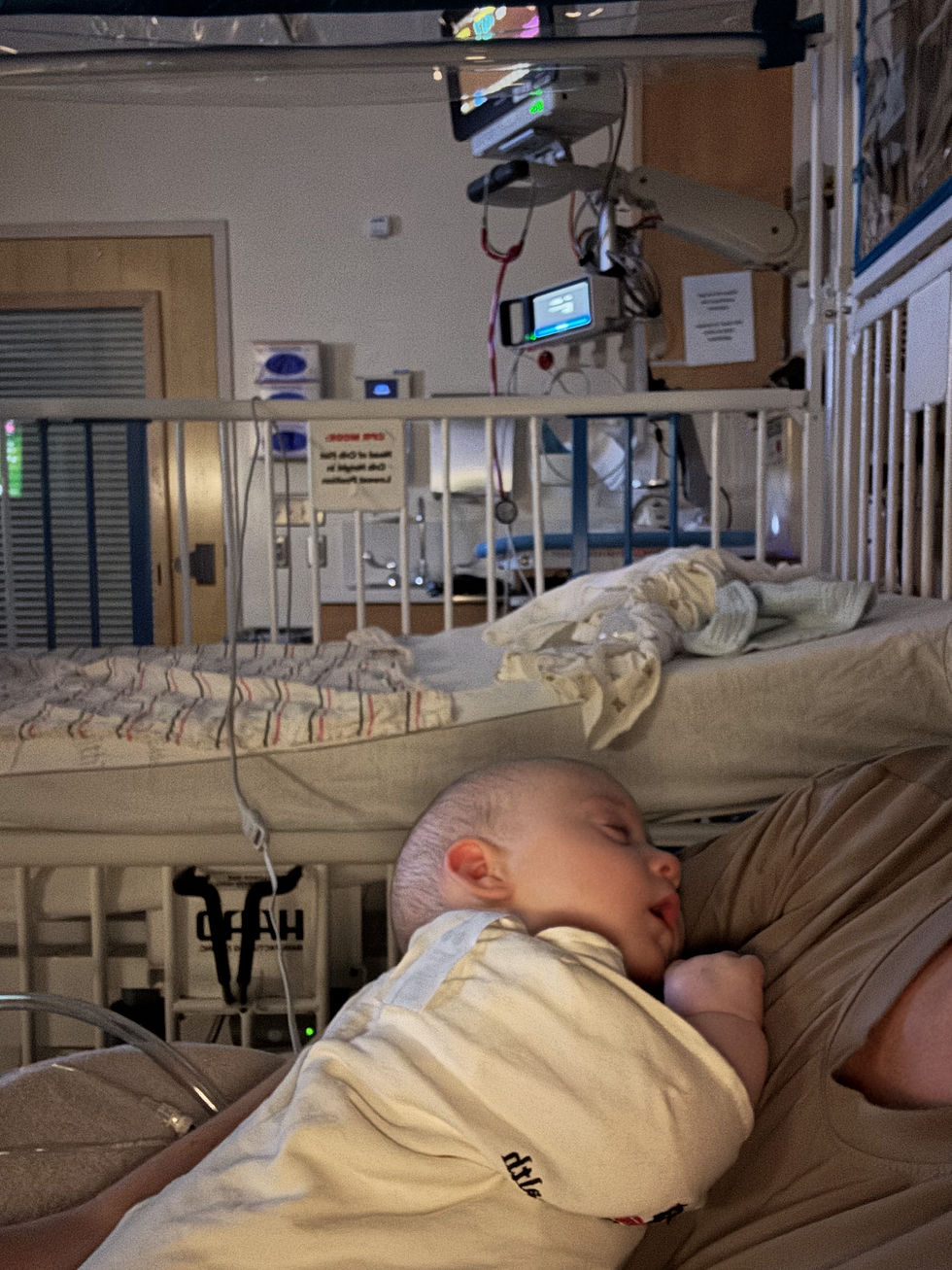
Eventually, I laid him in his hospital bed and tried to sleep beside him.
If you have ever tried to sleep in a hospital room next to a bed where your child is the patient, then you know there isn’t much sleeping involved.
There are vital signs.
IV checks.
Catheter bags to empty.
Machines beeping.
Doors opening.
Nurses coming and going.
But even in the quiet moments, there is anxiety.
You close your eyes, but some part of your brain stays awake.
Listening.
On edge.
Ready to react.
If you know that feeling because you have lived it yourself, my heart breaks for you too.
It is an experience I wouldn’t wish on my worst enemy.
Handing Him Over
Morning finally came, and I was desperate to know when Beckham would go to surgery.
We were told sometime around 1 or 2 p.m.
My heart sank again.
He couldn’t eat, and I was terrified he would spend hours crying from hunger.
But thankfully—and sadly—he didn’t seem particularly bothered.
Poor appetite and increased sleepiness can accompany a shunt malfunction as pressure builds inside the brain.
So instead of wanting to eat, Beckham mostly wanted to sleep in our arms.
And if there was one thing I was more than willing to give him that day, it was extra snuggles.

Julian and I took turns holding him until the nurse finally came to take us downstairs.
We were able to stay with Beckham in the pre-operative area.
We spoke with anesthesia.
We signed the consents.
Then a sweet blonde nurse walked out and told us she would be caring for Beckham in the operating room.
…And she was ready to carry him back.
Julian and I kissed our baby goodbye.
We told him we loved him.
Then I had to hand him over to someone I just met.
I looked at her and said:
“Please take good care of him.”
She looked back at me.
“I promise I will.”
And then I turned around.
Because I physically could not watch my baby disappear behind those doors.
The tears immediately filled my eyes, and it took everything in me not to completely fall apart.
As Julian and I walked back toward his room to wait, my mind went to places I wish it didn’t.
Was he lying on that cold operating table underneath those bright lights?
Was he looking around at unfamiliar faces, wondering where Mommy went?
Were they putting his breathing tube in?
Were they cutting into my baby’s scalp?
Were they operating on his tiny brain?
Brutal thoughts.
But they were also the reality of what my baby was going through.
A few hours later, the surgeon walked into our room.
The surgery was finished.
Beckham had done well.
They confirmed what the imaging suggested: the catheter tip was no longer inside the ventricle where it needed to be to drain cerebrospinal fluid.
The surgeon placed the new catheter deeper, hoping that this one could accommodate Beckham’s growth and stay in place for a very long time.
Maybe, God willing, forever.
The surgeon expected another day or two in the hospital before we could go home.
We thanked him.
And then we waited for the only thing I cared about at that moment:
Seeing my baby.
Back in My Arms
A few minutes later, I heard a bed rolling down the hallway.
Then I heard whining.
I knew that cry immediately.
It was Beckham.
As they wheeled him into the room, I could see old blood smeared around his incision. He was visibly shivering from the anesthesia, crying harder as he became more awake and increasingly confused by everything happening around him.

And in that moment, I would have given anything to trade places with him.
To take his pain.
To carry it for him.
Then I heard the words I had been waiting for:
“You can pick him up if you want.”
I scooped him into my arms and held him tightly against my chest.
I gave him his pacifier.
I whispered into his ear.
“I’m so sorry, baby. You’re okay. You’re going to be okay.”
After several minutes of crying and fussing, his little body finally relaxed.
He fell asleep against me.
And I just stared at him.
I rubbed his tiny hands and fingers.
I studied his sweet face.
And I thanked God that he was safely back in my arms.

The rest of the afternoon became a blur.
Beckham slept for most of it.
Then, early that evening, the pain hit.
He began screaming harder than I had ever heard him scream. He would cry so intensely that he would briefly hold his breath, and his lips would turn a terrifying bluish-purple.
I tried everything.
Holding him.
Rocking him.
Talking to him.
His pacifier.
Nothing worked.
There are few things more heartbreaking than watching your baby scream in pain—confused, frightened, and unable to understand why he hurts—while you feel completely helpless because nothing you’re doing is making it better.
I called his nurse and asked if he could have something stronger than Tylenol.
She gave him oxycodone, and thankfully, once it kicked in, glimpses of my sweet boy started coming back.
Smiles.
Legs kicking.
Even a giggle or two before the night was over.
And with each one, my heart mended just a little.

Home
Another night passed.
Then came Tuesday.
And finally, the words all hospital parents wait desperately to hear:
“You can go home.”
I think all three of us were more than ready.
And maybe I’m imagining it, but I swear Beckham recognized home the moment we walked through the door.
There seemed to be an immediate sense of happiness and relief on his face as he looked around at everything familiar.
His home.
His room.
His safe place.
That night brought the sleep all three of us desperately needed.
Beckham fell asleep sometime between 10:30 and 11 p.m. and didn’t wake until 8:30 the next morning.
He had never slept that long overnight.
And for the first time in days, we could breathe a little easier.
Until Wednesday.
“Please”
Julian and I started noticing that Beckham’s fontanelle felt full again.
And just like that, the anxiety came roaring back.
Was something wrong with this new shunt?
Was this swelling?
Was his body simply adjusting as the fluid and pressure inside his head normalized?
Were we about to do this all over again?
For the next two days, Julian and I constantly debated whether we needed to take him back to the emergency room.
We were on edge.
Sleep-deprived.
Coming down from an incredibly traumatic and overwhelming few days.
Running on fumes.
And now, just as we had started to believe the worst was behind us, fear had found its way back in.
Eventually, I broke.
I locked myself in the bathroom.
Walked into my closet.
Got down on my knees.
And sobbed so hard I could barely breathe.
I looked toward the ceiling, put my hands together, and tried to pray.
But I didn’t have an eloquent prayer.
I didn’t have the right words.
There was only one word I could get out.
“Please.”
Over and over again.
“Please.”
In my mind, I begged:
Please let my baby be okay.
Please let his shunt be working.
Please don’t make him go through this again.
Please.
That was all I had left.
And I believe God heard me.
Maybe the shunt was working perfectly the entire time.
Maybe his body simply needed time.
I don’t know.
What I do know is that as I sit here on Friday finishing this post, Beckham’s fontanelle is getting softer.
Day by day, the fear is beginning to loosen its grip.
And we are home.
Grateful
This week reminded me, once again, that this journey can change in an instant.
One morning, you are leaving for work after sleepy 4 a.m. snuggles with your baby.
Hours later, you are packing an overnight bag because something inside you knows you are headed toward another hospital admission.
The next day, you are handing your baby to a stranger and trusting her to carry him into an operating room you cannot enter.
And a few days later, you are on your knees in a closet because you no longer have enough strength to form a prayer beyond one word:
Please.
There is so much about Beckham’s journey that I cannot control.
I cannot control whether his shunt fails again.
I cannot control whether another surgery waits somewhere in our future.
I cannot protect him from every painful thing this life may ask him to endure.
And accepting that may always be one of the hardest parts of being his mom.
But I can hold him through it.
I can advocate for him.
I can learn from the moments when I wish I had spoken louder.
I can kiss him before they carry him through the operating room doors.
I can be there when he wakes up.
I can whisper, “You’re okay, baby,” until he believes he is safe again.
And when everything becomes too heavy for me to carry, I can get down on my knees and give it all to God.
Today, I am simply grateful.
Grateful for a successful surgery.
Grateful for the doctors and nurses who cared for our sweet boy.
Grateful that his fontanelle continues to feel softer.
Grateful that, so far, we are seeing no signs of complications.
Grateful that Beckham is healing, smiling, and getting stronger again.
Grateful to be home.
And incredibly grateful for our village—for every person who checked on us, prayed for Beckham, offered to help, sent a message, or simply reminded us that we weren’t walking through another terrifying chapter alone.
I don’t know what the future of Beckham’s journey will look like.
I’m learning not to look too far ahead.
For now, he is home.
He is healing.
He is safe in my arms.
And today, that is all I need.


Comments